记忆、模型、机器人 / Memory, Models, Robots
Published:
Originally published on WeChat as 记忆、模型、机器人. This version keeps the Chinese original and an English translation side by side.
很多人好奇妙动科技在做什么,怎么创业到现在一点消息也没有。确实,我们一点消息也没对外讲,因为团队正在静默状态,非常认真地打磨产品。在2025年岁末,我说两点很个人的想法,权当对这一年的总结。
Many people are curious about what Mondo Robotics is doing, and why there has been almost no news since we started the company. That is true: we have said almost nothing publicly, because the team has been working quietly and seriously on the product. At the end of 2025, I want to share two very personal thoughts as a kind of year-end reflection.
2. 记忆
2. Memory
2023年,我刚到特斯拉Optimus团队的控制组。团队的构成很多元,全组十三个人里汇聚了来自九个国家的面孔:比利时、西班牙、意大利、德国、美国、加拿大、印度、韩国、中国(我)。我经常在午饭时间组织号召大家共进午餐。在我之后加入团队的第二个德国大哥,金发碧眼,言谈举止却透着一股非德国式的豪放,甚至隐约带点“毛子”气质。在午饭闲聊时,他说起自己出生在哈萨克斯坦。这时候我才知道,二战期间斯大林将伏尔加河德意志人流放到西伯利亚,这一整个民族直到苏联解体才得以回归德国。后来有一次,我带儿子去他家拜访,他做了一锅孜然味浓郁、香气四溢的胡萝卜羊肉手抓饭。他说这是他记忆中家乡的味道,我说在我们国家的新疆,人们也用同样的方式烹饪羊肉。
In 2023, I had just joined the controls group on Tesla's Optimus team. The team was very diverse: among thirteen people, there were faces from nine countries: Belgium, Spain, Italy, Germany, the United States, Canada, India, Korea, and China, meaning me. I often gathered everyone for lunch. The second German colleague who joined after me had blond hair and blue eyes, but his manner carried a kind of non-German boldness, even a faintly Russian air. Over lunch, he mentioned that he was born in Kazakhstan. That was when I learned that during World War II, Stalin exiled the Volga Germans to Siberia, and that this entire ethnic group did not return to Germany until after the Soviet Union collapsed. Later, I took my son to visit his home. He cooked a pot of carrot and lamb pilaf, rich with cumin and fragrance. He said it was the taste of home in his memory. I said that in Xinjiang, in my country, people cook lamb in the same way.
Optimus团队在控制组之外,也有很多来自不同民族和文化背景的人。有个斯拉夫工程师让我印象极深,因为我面试特斯拉的时候,他考我的正是我的看家技能卡尔曼滤波。从面试的第一面起,我就觉得他的眉宇间似乎总是锁着一层淡淡的、散不去的忧伤。后来有一次一起午餐,他说他还有很多亲人在哈尔科夫。另外还有一个经常和我合作的黎巴嫩人,在2024年夏天突然离职了,他说他要回贝鲁特照顾他的妈妈。几个月后,当以色列开始轰炸贝鲁特的时候,我在Linkedin上问候他情况怎么样,他回复说目前还不算太糟。
Outside the controls group, Optimus also had many people from different ethnic and cultural backgrounds. One Slavic engineer left a deep impression on me, because when I interviewed at Tesla, he tested me on my signature skill: Kalman filtering. From the first interview onward, I felt there was always a faint, unshakable sadness between his brows. Later, at lunch, he said many of his relatives were still in Kharkiv. There was also a Lebanese colleague I worked with often who suddenly left in the summer of 2024. He said he needed to return to Beirut to take care of his mother. A few months later, when Israel began bombing Beirut, I asked him on LinkedIn how he was doing. He replied that things were not too bad for now.
2024年,我和妻子给儿子选了一所犹太人学校上了一年幼儿园。他最好的朋友之一是一个犹太小女孩。有一次放学后,我们两家人坐在学校外的咖啡馆一起吃东西,我听到她的外婆在和她讲一些听起来音节有些熟悉的语言,我和儿子用英语说:“Sharoni在和她的外婆讲俄语。” 那位有着金色头发、身材魁梧、戴着深色墨镜的外婆猛地转向我,用生硬且不容置疑的英语说道:“Ukrainian. No Russian.”(乌克兰语,不是俄语。)惊愕与尴尬之下,我一时语塞,只能报以歉意的傻笑。很久以后,我和Sharoni的妈妈谈起这件事,表达了我的抱歉,才知道她们家是乌克兰人,而Sharoni的爸爸则是犹太人。2025年夏天,以色列和伊朗开始交火。有一天,儿子和Sharoni又在加州明媚的阳光下一起玩耍,我的妻子和Sharoni的妈妈在一旁闲聊。临别时,我们得知Sharoni年事已高的奶奶住在以色列,因为总是要在深夜随着警报声紧急跑向防空洞,老人受不了这种惊恐的刺激,在特拉维夫去世了。但是Sharoni的爸爸没办法飞回去奔丧,因为以色列的空域已经封锁,他当时正在约旦,焦急地探寻着有没有办法从陆路进入以色列。再过了一阵子,Sharoni的爸爸回来了,我却始终没有机会问起他母亲的后事如何。
In 2024, my wife and I chose a Jewish school for our son, where he spent a year in preschool. One of his best friends was a Jewish girl. One day after school, our two families sat outside the school cafe eating together. I heard her grandmother speaking to her in a language whose syllables sounded familiar, and I said to my son in English, "Sharoni is speaking Russian with her grandmother." The grandmother, with blond hair, a sturdy build, and dark sunglasses, turned sharply toward me and said in stiff, unquestionable English: "Ukrainian. No Russian." Startled and embarrassed, I was speechless and could only offer an apologetic, awkward smile. Much later, when I spoke with Sharoni's mother about it and apologized, I learned that their family was Ukrainian, while Sharoni's father was Jewish. In the summer of 2025, Israel and Iran began exchanging fire. One day, our son and Sharoni were playing again under the bright California sun while my wife chatted with Sharoni's mother. As we were leaving, we learned that Sharoni's elderly grandmother lived in Israel. Because she had to run to a shelter at night whenever alarms sounded, the terror became too much for her, and she passed away in Tel Aviv. Sharoni's father could not fly back for the funeral because Israeli airspace had been closed. He was in Jordan at the time, anxiously looking for a way to enter Israel by land. After some time, Sharoni's father returned, but I never found the chance to ask what happened afterward with his mother's funeral.
十二月初,我以前在匹兹堡的邻居Halpern先生突然发短信来,说虽然不知道我们在世界的哪个角落,但是希望我们一切都好。他还在絮叨着匹兹堡我们那个小区的一切依旧是老样子,前几天落下了入冬后的第一场雪,积雪足有四英寸深,他们已经挂起了圣诞节的装饰。儿子在匹兹堡出生的时候,Halpern夫妇就住在我们家隔壁,他们听过我们儿子在客厅里清脆的啼哭声,也听过我在压力极大的倾诉。我们告诉他,我们的儿子Mason已经长高长大了,如今正在深圳上学。
In early December, my former neighbor in Pittsburgh, Mr. Halpern, suddenly texted me. He said that although he did not know where in the world we were, he hoped we were all well. He went on about how everything in our old Pittsburgh neighborhood was still the same: the first snow of winter had fallen a few days earlier, four inches deep, and they had already put up Christmas decorations. When our son was born in Pittsburgh, the Halperns lived next door. They heard our son's clear cries from our living room, and they also heard me speak during moments of tremendous pressure. We told him that our son Mason had grown tall and was now going to school in Shenzhen.
我的儿子是一个性格非常敏感的孩子,他有着敏锐的情绪感知力,总是能捕捉到周围人的情绪波动,并且担忧自己是造成父母负面情绪的源头。我和妻子尽自己所能地呵护着他,不过他还是会常常问出“五十亿年后太阳毁灭时我们还活着吗”这样深刻得令人心颤的问题。回国之前,妈妈告诉他,妈妈在深圳出生长大,他歪着头想了想,问道:“深圳是妈妈的匹兹堡吗?”
My son is a very sensitive child. He has a keen sense for emotion, always catching the emotional fluctuations of people around him, and worrying that he might be the source of his parents' negative feelings. My wife and I protect him as best we can, but he still often asks questions so profound they make one's heart tremble, like, "Will we still be alive when the sun dies in five billion years?" Before we returned to China, his mother told him that she was born and raised in Shenzhen. He tilted his head, thought for a moment, and asked, "Is Shenzhen Mommy's Pittsburgh?"
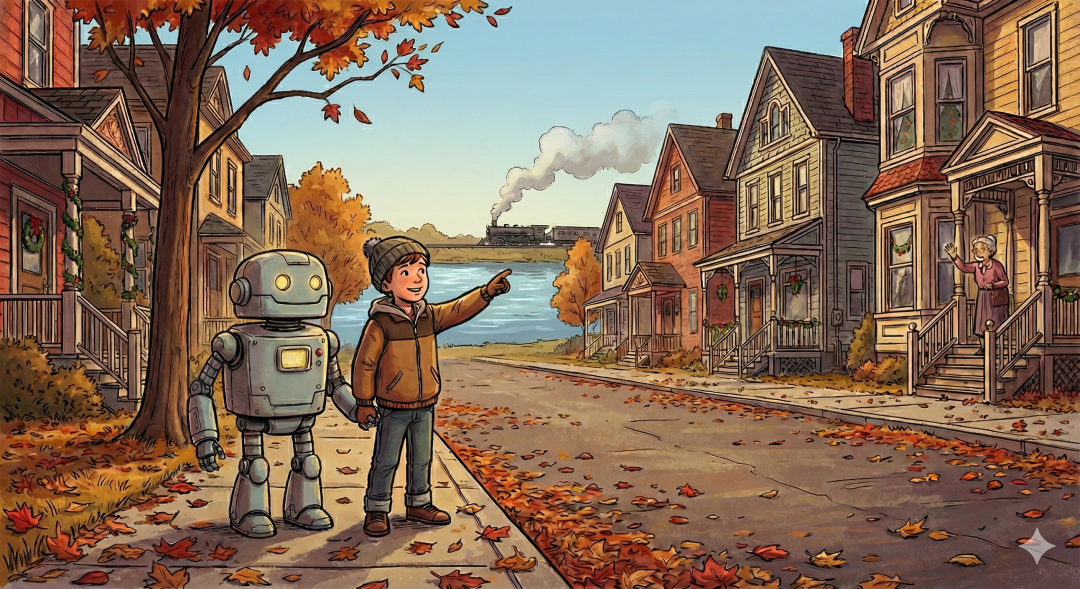
收到Halpern先生短信的那天晚上,我梦到我带着妻子和儿子回到了匹兹堡我们以前住的小房子外面。秋天快要过去了,金黄火红的枫叶如燃烧的晚霞般落满了街道,微冷潮湿的空气里裹挟着远方悠扬而凄清的火车汽笛声。住在街对面房子里的Joan老婆婆,坐在前厅的窗前,向我们微笑着挥手。
The night I received Mr. Halpern's text, I dreamed that I had brought my wife and son back to the little house where we used to live in Pittsburgh. Autumn was almost over. Golden and crimson maple leaves, like burning sunset clouds, covered the streets. The cold, damp air carried the distant, lingering, mournful sound of a train whistle. Joan, the elderly woman who lived across the street, sat by the front-room window and smiled and waved to us.
离开匹兹堡之前,我和妻子带着儿子去拜访Joan老婆婆。她99岁了,丈夫前年在101岁高龄上过世,她继续独自在两人共同生活过的大房子里住着,每隔几天就请人来打扫家或者收拾花园。我们在她那个井井有条、一尘不染的客厅坐下。她说起她的丈夫以前是Westinghouse(西屋电气公司)的工程师,她说话时的神情,让我想起我在太原的姥姥——她的丈夫也在去年过世了。一个生于后冷战时期的中国人,该怎么去安慰和共鸣一个生于咆哮二十年代的美国人的悼亡之情?这实在是任何一本英语课本上都不曾涉及的生命课题。我想谈论一下我去世的姥爷,但我不知道这在文化上是否突兀,于是话到嘴边又咽了回去。但话题很快转到了新的生命上,Joan吃力地站起来,从她的柜子上拿来一个精致的猫头鹰雕塑送给我的儿子,她问我:“Will he remember me?”(他会记得我吗?)我说,他一定会的。
Before leaving Pittsburgh, my wife and I took our son to visit Joan. She was ninety-nine. Her husband had passed away the year before at the age of 101, and she continued to live alone in the large house they had shared, hiring someone every few days to clean or tend the garden. We sat in her orderly, spotless living room. She talked about how her husband had once been an engineer at Westinghouse. The expression on her face as she spoke reminded me of my grandmother in Taiyuan, whose husband had also passed away the year before. How should a Chinese person born after the Cold War comfort and resonate with the grief of an American born in the Roaring Twenties? This was truly a life lesson no English textbook had ever covered. I wanted to talk about my late grandfather, but I did not know whether that would feel culturally abrupt, so I swallowed the words. The conversation soon turned to new life. Joan stood up with difficulty, took a delicate owl sculpture from her cabinet, and gave it to my son. She asked me, "Will he remember me?" I said he certainly would.
我还未来得及细细咀嚼这一切的意义,就搬回了深圳,开启了创业生涯。公司研发业务转起来后忙得不可开交,我和2015年一样,每天清晨挤入地铁的人流。坐二号线到科苑地铁站下车时,我会习惯性地用起十年前就学会的窍门:下车后小跑到扶梯口,以避免被急着上班的汹涌人潮裹住而挤不上扶梯。这一切都让我产生一种错觉,仿佛当年在科技园奋斗的日子就在昨天,而在匹兹堡和硅谷生活的时光却像是好久以前的故事。Halpern先生发来短信的时候,妙动的团队正要开始给机器人产品设计Agent系统,我们在仔细思考它们在人们家庭里的角色和定位,于是过往这些生活中的记忆片段,就像巴赫的大提琴曲一样,深沉而连绵地又流过我的心里。
Before I had time to fully digest the meaning of all this, I moved back to Shenzhen and began life as a founder. Once the company's R&D work got moving, things became overwhelming. Just like in 2015, I squeezed into the subway crowd early every morning. When Line 2 reached Keyuan Station, I habitually used the trick I had learned ten years earlier: after getting off, jog to the escalator so I would not be swept up by the surging commute crowd and miss the chance to get on. All of this gave me the illusion that those days of struggling in the Science and Technology Park were only yesterday, while life in Pittsburgh and Silicon Valley felt like stories from long ago. When Mr. Halpern sent his message, the Mondo team was just starting to design agent systems for robot products. We were carefully thinking about their roles and positions in people's homes. And so those fragments of memory from life flowed through my heart again, deep and continuous, like Bach's cello suites.
年中接受WhyNotTV采访的时候,很多人不理解我为什么大段谈论机器人应该理解死亡。如果时间允许,我想和你讲讲我上述故事中的每一个瞬间的细节——我儿子出生那天,灰色的天空飘零着细碎的雪花;Joan拖着做过手术后略显不协调的身躯,带着园丁在花园里缓缓踱步,嘱咐该如何照料那些鲜艳欲滴的花儿;我的苏联德国同事在厨房里,眼神专注地看着锅里手抓饭冒出的蒸汽,如游丝般袅袅升起。我希望我的机器人帮我记住这一切,我相信每个人都有这样情感丰富的瞬间需要被记住。
When I was interviewed by WhyNotTV in the middle of the year, many people did not understand why I spent so much time talking about how robots should understand death. If time allowed, I would tell you the details of every moment in the stories above: the day my son was born, when fine snow drifted from a gray sky; Joan, moving slowly through the garden with a body made slightly uneven after surgery, telling the gardener how to care for those vivid flowers; my Soviet German colleague in the kitchen, staring intently as steam rose in wisps from the pot of pilaf. I want my robots to help me remember all this. I believe everyone has emotionally rich moments like these that need to be remembered.
2025年末,我们已经非常确定,虽然当前的大模型架构是不是通向AGI的路仍有争议,但是深度学习的过程——将高维信息压缩到隐空间、再进行信息重建——可以带来智能的涌现,这是一个确凿无疑的技术结论,是革命之路的正确方向,会继续深刻地变革包括机器人学在内的许多学科。但真的只是这样吗?人类有能力把圆周率算到一百万亿位,人类能够拆开一百亿分之一米的质子一探究竟,人类理解宇宙从过去一百亿年到未来一百亿年的历史和命运可能,造就这一切的思考、交流、好奇与爱,都只是某个冰冷的高维隐空间的映射而已吗?如果多年以后,我有机会把我的公司造出来的机器人送到Sharoni这样的孩子的手上,她会怎么和它对话?她会用英语,还是希伯来语、乌克兰语?她怎么理解那位辗转来到美国的乌克兰外婆的沧桑经历?她怎么看待她在以色列的根?如果多年以后,我的公司造出来的机器人陪着Joan坐在匹兹堡傍晚清冷的微风里,她会和它讲逝去的先生的故事吗?我确定机器人的大模型会把她的话语映射为一个隐空间,但在那里的向量,也能够重建出我在太原的姥姥发给我的那些悼念她丈夫的话语吗?我尚未了解到有哪一个人工智能的分支学科可以回答我的问题。也许最后答案是“你儿子那些脆弱的情绪和另一个同样软弱的小孩说的话,只是对两个KL divergence比较小的概率分布的采样”。但我依然选择相信,我们需要更多的人工智能技术,而不仅仅是信息的压缩和映射。同样,我们造出来的机器人,不应该只是“代替人做无聊的事”这么简单,他们应该帮助人类更好地认识自己,洞彻出生和死亡的困惑,理解个体不应该被属于一个群体或不属于一个群体而定义。
By the end of 2025, we are quite certain of one thing: although it remains disputed whether today's large-model architectures are the path to AGI, the process of deep learning, compressing high-dimensional information into latent space and then reconstructing it, can lead to the emergence of intelligence. This is an undeniable technical conclusion, the correct direction for a revolution, and it will continue to profoundly transform many disciplines, robotics included. But is that really all there is? Humans can calculate pi to one hundred trillion digits. Humans can take apart a proton one ten-billionth of a meter wide to examine it. Humans can understand the history and possible fate of the universe across ten billion years in the past and ten billion years in the future. Are the thought, communication, curiosity, and love that make all of this possible merely mappings in some cold, high-dimensional latent space? If many years from now I have the chance to put a robot built by my company into the hands of a child like Sharoni, how will she speak with it? In English, Hebrew, or Ukrainian? How will she understand the weathered life of her Ukrainian grandmother who made her way to America? How will she see her roots in Israel? If many years from now a robot built by my company sits with Joan in the cool evening breeze of Pittsburgh, will she tell it stories about her late husband? I am sure the robot's large model will map her words into a latent space, but can the vectors there also reconstruct the messages my grandmother in Taiyuan sent me as she mourned her husband? I have not yet learned of any branch of artificial intelligence that can answer my question. Perhaps the final answer will be that "your son's fragile emotions and the words of another equally vulnerable child are just samples from two probability distributions with relatively small KL divergence." But I still choose to believe that we need more artificial intelligence technology, not merely compression and mapping of information. Likewise, the robots we build should not simply "replace people in doing boring things." They should help human beings better understand themselves, see through the confusion of birth and death, and understand that individuals should not be defined by whether they belong, or do not belong, to a group.
1. 模型
1. Models
2024-2025年对我打击最大的事情,当属机器人学界关于人形机器人全身行走运动控制应该采用模型预测控制(MPC)还是强化学习(RL)的争论。2024年整年里,我在特斯拉使尽平生所学,想把MPC用在全尺寸人形机器人Optimus上。MPC是一套理论非常漂亮的框架:我们把机器人的运动轨迹规划构造成有物理模型约束的数值优化问题,并采用数值优化算法实时求解。问题构造完成后,不管是哪种数值优化算法,对于约束的处理都是把它们变化为目标函数的一部分。无数科学家为了优化的数值稳定性付出了艰辛的努力,提出了各种变化约束的思路,特别是augmented Lagrangian,从构造到求解都闪耀着人类智慧的光芒。我在博士期间花了两年时间认认真真地学习数值优化,除了一套手动推导KKT条件应用ADMM的屠龙之技以外,还钻研了Eigen底层的代码,写过稀疏矩阵的分块求解器。然而这些都没什么用。年尾,痛定思痛,切换成了时下最流行的强化学习RL技术,之后仅用了一个多月的时间就调出一个神经网络控制器让机器人跑步上山,此时我的震惊之情难以言表。
The thing that struck me hardest in 2024 and 2025 was the debate in robotics over whether whole-body walking control for humanoid robots should use model predictive control, MPC, or reinforcement learning, RL. Throughout 2024 at Tesla, I used everything I had learned in my life trying to apply MPC to the full-size humanoid robot Optimus. MPC is a theoretically beautiful framework: we formulate the robot's motion trajectory planning as a numerical optimization problem constrained by a physical model, and solve it in real time with numerical optimization algorithms. Once the problem is formulated, no matter which numerical optimization algorithm is used, constraints are handled by turning them into part of the objective function. Countless scientists have worked hard on numerical stability, proposing many ways to transform constraints, especially augmented Lagrangian methods. From formulation to solution, the whole field shines with human intelligence. During my PhD, I spent two years seriously studying numerical optimization. Beyond the dragon-slaying skill of manually deriving KKT conditions and applying ADMM, I also studied Eigen's low-level code and wrote sparse-matrix block solvers. Yet none of that was useful. At the end of the year, after painful reflection, I switched to the currently popular RL approach. In just over a month, I tuned a neural-network controller that let the robot run uphill. The shock I felt is hard to describe.
在世界上所有点错科技树的机器人科学家里,我应该是比较懊悔的一个。过去八年的职业生涯里我做的选择包括:2017年拿了伯克利phd的offer没有去(甚至还和Sergey Levine稍微聊了一会儿“我认为神经网络的中间层应该编码了一些物理表征”);2021年在Nvidia实习时参与了Isaac Gym和Isaac Lab早期版本的开发,但是也没去搞RL(甚至还和ETH的Nikita Rudin、David Hoeller一起做了项目,旁观了他们用Isaac Gym做出来那篇RL locomotion的开创性工作)。在人类这一段机器人学突破性进展的时期里,我并没有参与到最突破性的工作里。
Among all the roboticists in the world who chose the wrong technology branch, I am probably one of the more regretful. Over the past eight years of my career, my choices included: in 2017, receiving a PhD offer from Berkeley and not going, even after briefly talking with Sergey Levine about how "I think the middle layers of neural networks should encode some physical representations"; in 2021, interning at Nvidia and participating in early versions of Isaac Gym and Isaac Lab, but still not working on RL, even after collaborating with ETH's Nikita Rudin and David Hoeller and witnessing their pioneering RL locomotion work built with Isaac Gym. During this period of breakthrough progress in robotics, I did not participate in the most breakthrough work.
这个科研思路来自于一个坚持——我相信我们对机器人的控制器应该是全面可解释的、可控制的,它不应该是由神经网络的隐变量决定的,而是由物理学规律和数学公式详细推导出来的。我的第一个导师Howie Choset已经在几何控制(Geometric Control)上一无所获地探索了十几年,没有任何理论可以让机器蛇被控制得更好;我的第二个导师Zachary Manchester同样苦苦求索基于模型的控制方法而没有重大收获。在我的整个博士期间,我都在二战以来最优控制和数值优化的文献中绝望地发掘,希望能找到某些上古绝学可以解决当代的问题。博士生涯中期,我找到一个新颖的方式求解带有跨时域的等式约束的LQR问题,数学上非常漂亮,虽然没有实用价值,但小小增强了我的信心。没曾想这就是结局了,此后无论如何很难再做出新东西。现在我可以非常确定地说,这些控制的范式和方法论有本质的局限性,我们必须对他们做出非常本质的修改,否则这些人类智慧的光芒可能只能在垃圾桶里闪耀了。
This research direction came from one conviction: I believed that robot controllers should be fully interpretable and controllable. They should not be determined by hidden variables in a neural network, but derived in detail from the laws of physics and mathematical formulas. My first advisor, Howie Choset, explored geometric control for more than a decade without much success; no theory made robot snakes substantially easier to control. My second advisor, Zachary Manchester, also pursued model-based control methods with great effort but without major breakthroughs. Throughout my PhD, I desperately dug through the literature on optimal control and numerical optimization since World War II, hoping to find some ancient secret technique that could solve contemporary problems. In the middle of my PhD, I found a novel way to solve LQR problems with equality constraints across time horizons. It was mathematically beautiful and not practically useful, but it modestly strengthened my confidence. I did not expect that to be the ending. After that, no matter what I tried, it became very hard to produce something new. Now I can say with great certainty that these control paradigms and methodologies have essential limitations. We must modify them at a very fundamental level; otherwise, the light of human intelligence in them may only shine from the trash can.
当前妙动科技的技术团队大量使用了强化学习和深度学习技术开发机器人的运动控制器和操作控制器,我也在不停地学习相关的知识和技术。我们已经做出了一些很棒的产品原型、运动算法和人形操作模型方面的成果可以在2026年公布,但我无时无刻不在思考为什么基于模型的范式没能帮我们解决人形机器人的控制问题,我们应该怎么继续利用这些“屠龙之技”。
At Mondo Robotics, our technical team now makes extensive use of reinforcement learning and deep learning to develop robot locomotion and manipulation controllers, and I am continuously learning the relevant knowledge and techniques. We have already built some excellent product prototypes, motion algorithms, and humanoid manipulation model results that can be announced in 2026. But I am constantly thinking about why the model-based paradigm failed to help us solve the control problems of humanoid robots, and how we should continue to make use of these "dragon-slaying" skills.
2025年中逐渐变得比较清晰的一个事实是,MPC可能只是错在“实时”这一个要求上,它是人类现有技术水平达不到的。而“把机器人的运动轨迹规划构造成有物理模型约束的数值优化问题并采用数值优化算法求解”依然是极其有价值的事情,并且在当代机器人学中广泛应用。首先,强化学习在人形机器人控制领域高歌猛进的基础是仿真器——不管是Mujoco还是PhysX,底层都在把机器人的动力学仿真构造成数值优化问题并求解。其次,近半年来很多人形机器人技术的进展也依赖于把数值优化技术重新引入仿人运动的流程中,比如OmniRetarget这篇论文的作者Lujie Yang是机器人数值优化领域的专家Russ Tedrake的学生,运用了很多数值优化技术来提升人类动作到机器人动作的映射。第三,学习MPC能够让学生更理解多变量系统控制的本质和难点,具备更好的理解和应用强化学习技术的基础,比如BeyondMimic这篇论文的作者Qiayuan Liao从2018年就开始和我学习基于模型的控制方法,在MPC上也曾做出过杰出工作。
By the middle of 2025, one fact gradually became clearer: perhaps MPC is wrong only in its requirement of being "real time," something beyond the current level of human technology. The idea of "formulating a robot's motion trajectory planning as a numerical optimization problem constrained by a physical model and solving it with numerical optimization algorithms" remains extremely valuable and is widely used in contemporary robotics. First, the rapid progress of reinforcement learning in humanoid robot control rests on simulators. Whether Mujoco or PhysX, their foundations formulate and solve robot dynamics simulation as numerical optimization problems. Second, many recent advances in humanoid robot technology have also relied on reintroducing numerical optimization into the human-to-robot motion pipeline. For example, Lujie Yang, the author of OmniRetarget, is a student of Russ Tedrake, an expert in robot numerical optimization, and used many numerical optimization techniques to improve the mapping from human motion to robot motion. Third, learning MPC helps students better understand the essence and difficulties of multivariable system control, giving them a stronger foundation for understanding and applying reinforcement learning. Qiayuan Liao, the author of BeyondMimic, began learning model-based control methods with me in 2018 and has also done outstanding work on MPC.
2026年,我在妙动的工作将致力于继续回答上述这些问题,特别是思考这些方法论应该如何应用在人形机器人全身操作上。我依然选择相信,物理学和数学是人类最纯净的智慧结晶,我们需要让神经网络显式地理解这些知识。人们现在都在关注world model,我很难相信一个不理解物理和数学的world model会有用。
In 2026, my work at Mondo will be devoted to continuing to answer these questions, especially how these methodologies should be applied to whole-body manipulation for humanoid robots. I still choose to believe that physics and mathematics are among the purest crystallizations of human intelligence, and that we need neural networks to explicitly understand this knowledge. Everyone is paying attention to world models now. I find it hard to believe that a world model that does not understand physics and mathematics will be useful.
0. 结尾
0. Closing
当前市场很热,每个机器人公司都拼命发出自己的声音,拼命争夺“全球第一个XXX的机器人”的头衔。在我看来,告诉别人自己能做到什么,不是最重要的;告诉别人自己做不到什么,才是更加重要的。因为技术团队存在的目的是为了解决最困难的科学技术挑战,一群具有相同困惑的人一起组成团队才能走得更远。何况我们现在面临的挑战不是来自其他的人类,而是来自那个转角可见的“通用人工智能”,我们要对他展示的是:人类最脆弱的情感和信念,才是人类最强大的地方。
The market is very hot right now. Every robotics company is desperately trying to make its own voice heard, fighting for the title of "the world's first robot to do X." In my view, telling others what you can do is not the most important thing. Telling others what you cannot do is more important. The purpose of a technical team is to solve the hardest scientific and technical challenges; only a group of people with the same questions can go farther together. Besides, the challenge we now face does not come from other humans, but from the "general artificial intelligence" visible just around the corner. What we need to show it is this: humanity's most fragile emotions and beliefs are precisely humanity's greatest strength.